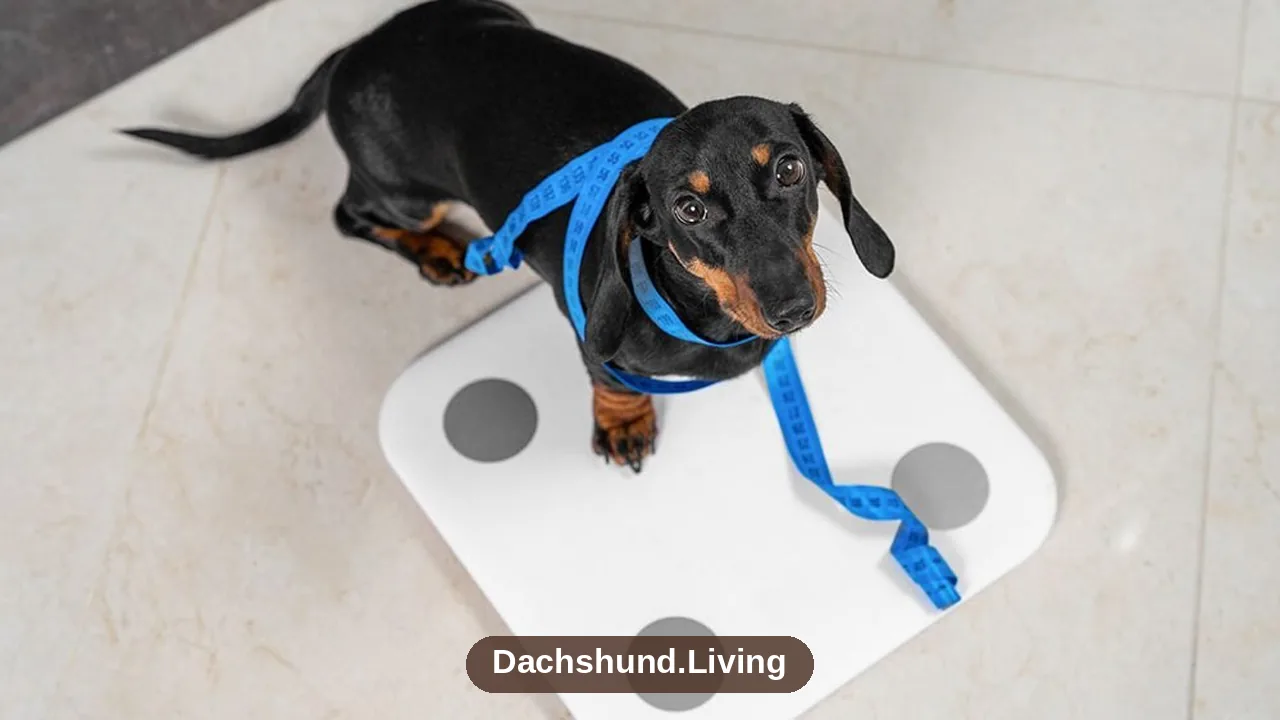

I weigh my dachshunds on the bathroom scale, holding them in my arms and then doing the maths. It is not elegant. It does stop the guessing.
Every owner I know has lifted their dog and thought, you feel heavier than last month. With this breed, that thought is worth taking seriously.
I am Umar, a dachshund owner, not a vet. A pound or two sounds like nothing on a big dog. On a long, low dachshund, it changes how the back and joints cope every day.
The Short Answer
An adult standard dachshund weighs 16 to 32 pounds. An adult miniature weighs 11 pounds and under, at 12 months of age.
Those figures come from the AKC dachshund breed standard, which vets and breeders use as their starting point too. Dogs between the two ranges, 12 to 16 pounds or so, are what owners call tweenies.
Tweenie is not an official class. It is a handy word for a dog who is too big for a miniature and small for a standard, and plenty of healthy pets land there.
Adult Weight Chart
| Type | Adult weight | Weight in kg |
|---|---|---|
| Miniature | 11 pounds and under | About 5 kg and under |
| Tweenie | 12 to 16 pounds | About 5.5 to 7.3 kg |
| Standard | 16 to 32 pounds | About 7.3 to 14.5 kg |
That standard range is wide for a reason. A fine boned 18 pound standard and a solid 30 pound standard can both be in good shape, because frame and muscle differ so much.
Use the chart as a starting point, then judge the dog in front of you. Our guide to dachshund sizes explains how the varieties differ in height and build as well.
Know Which Type You Have
Read the scale with the type in mind. A 14 pound dog could be a lean tweenie, a heavy miniature, or a light standard, and each reading means something different.
Your breeder or rescue paperwork should say which variety you brought home. If it does not, ask your vet to judge by frame and parent size at your next visit.
For a tweenie, a personal target from your vet beats any chart. That target, written down, ends the family arguments about one more treat.
Puppy Growth, Month by Month
Puppies grow fast, then slow down in spurts. These ranges are averages from breeder and vet charts, and a healthy puppy can sit a little above or below them.
| Age | Miniature | Standard |
|---|---|---|
| 8 weeks | 2 to 4 pounds | 5 to 8 pounds |
| 3 months | 4 to 6 pounds | 8 to 12 pounds |
| 4 months | 5 to 7 pounds | 10 to 14 pounds |
| 6 months | 6 to 8 pounds | 12 to 18 pounds |
| 8 months | 7 to 9 pounds | 14 to 22 pounds |
| 10 months | 8 to 10 pounds | 15 to 26 pounds |
| 12 months | 11 pounds and under | 16 to 32 pounds |
I weighed my youngest every two weeks and wrote the numbers in a notebook. The trend told me far more than any single reading on a wiggly puppy.
Growth that runs far outside these ranges, month after month, deserves a mention at the vet. Fast growth can mean overfeeding, and slow growth can have causes your vet will want to rule out.
Most dachshunds reach adult height by 8 to 10 months. They keep filling out with muscle after that, and weight usually settles by 12 to 18 months.
Check the Dog, Not Just the Scale
Feel the Ribs
Run your hands along your dog’s sides with light pressure. You should feel the ribs easily under a thin layer of fat, without pressing hard.
If you have to dig through padding to find them, your dog is likely carrying extra weight. If the ribs feel sharp with no cover at all, your dog may be too thin.
Look for a Waist
Stand above your dog and look straight down. You should see a gentle inward curve behind the ribs, before the hips widen again.
From the side, the belly should tuck up a little toward the back legs. A belly that hangs level or sags is a sign to cut back and check with your vet.
Vets call this body condition scoring. VCA Hospitals explains obesity in dogs and how scoring works, and it is worth five minutes of reading.
Why Extra Pounds Hit This Breed Hard
Every step, jump and stair loads that long spine. Add extra pounds and the load grows, on a breed already prone to disc trouble.
Our guide to dachshund IVDD and back problems covers the warning signs in detail. VCA Hospitals notes that overweight dogs also face higher risks around joints and general health, so the back is not the only concern.
There is a dull cycle to watch for too. A heavier dog tires faster, walks less, and then gains more weight because he walks less. Catching it early breaks that cycle while it is still easy.
Keeping Weight in Check
Measure Every Meal
Eyeballing kibble is how my first dachshund gained weight. A measuring cup fixed it in a month, along with using the bag guide as a start and adjusting by body condition.
If you are picking food for a small dog, our notes on dog food for a mini dachshund cover portions and what to look for on the label.
Move a Little, Every Day
Two moderate walks a day plus some play keep most dachshunds in good shape. They were bred to work, and they have more stamina than those short legs suggest.
Our breakdown of dachshund exercise needs has ideas by age. Gentle fetch and sniff walks beat repeated jumping off the couch, which jars the spine.
Count the Treats
Treats are the quiet problem in my house. Training bits, a dental chew, a scrap from the table and a biscuit from a visiting aunt all land in the same dog.
I keep treats small, pea sized for training, and count them in the day’s food. One house rule helps most. Everyone feeds from the same measured pot, or nobody feeds at all.
Weight in Older Dogs
Seniors slow down, and the pounds can creep on even on the same food. A dog who charged around at 5 may stroll at 12, and his bowl needs to shrink to match.
I weigh my senior once a month and keep a short log. Our guide to senior dachshund care covers food changes and checkup timing for those years.
Sudden weight loss in an older dog worries me more than a slow gain. That goes straight to the vet, because it can signal a health problem that needs tests.
When to Ask Your Vet
Book a visit if your dog gains or loses weight fast, seems tired in a new way, or starts struggling with walks he used to enjoy. Sudden change, in either direction, is worth checking early.
If weight loss is needed, ask your vet to set the target and the pace. Safe loss is slow and steady, with monthly weigh ins to track it, not a crash diet from a forum post.
Watch a Weight Check in Action
This video shows how a dachshund weight check and body condition look in real life. Compare the waist and rib feel on screen with your own dog afterwards.
Frequently Asked Questions
How much should a miniature weigh in kg?
Eleven pounds is about 5 kg, so an adult miniature should sit at or under roughly 5 kg. Most healthy minis I have known weigh between 4 and 5 kg.
What is a healthy weight for a standard?
The standard range is 16 to 32 pounds, about 7.3 to 14.5 kg. Shape matters more than one exact number, so use the rib and waist checks alongside the scale.
At what age is a dachshund fully grown?
Height is usually done by 8 to 10 months. Weight settles by 12 to 18 months, once the last of the muscle fills in.
Is my dog overweight if I cannot feel ribs?
Quite possibly, yes. If you must press hard through fat to find the ribs, ask your vet for a body condition score and a feeding plan.
How fast can a dachshund lose weight safely?
Slowly, on a plan set by your vet, with monthly weigh ins to check progress. Crash diets are risky for dogs, and steady loss is the kind that stays off.
Keep a lean dachshund and you give his back its best chance at 10 and 12 years old. Weigh him monthly, trust your hands as well as the scale, and keep the measuring cup where everyone can see it.
A last note from me. This is owner experience, not veterinary advice, and I cannot set your dog’s ideal weight from a chart alone. Check with your own vet, who can feel your dog’s condition in person and set a target that fits his frame.