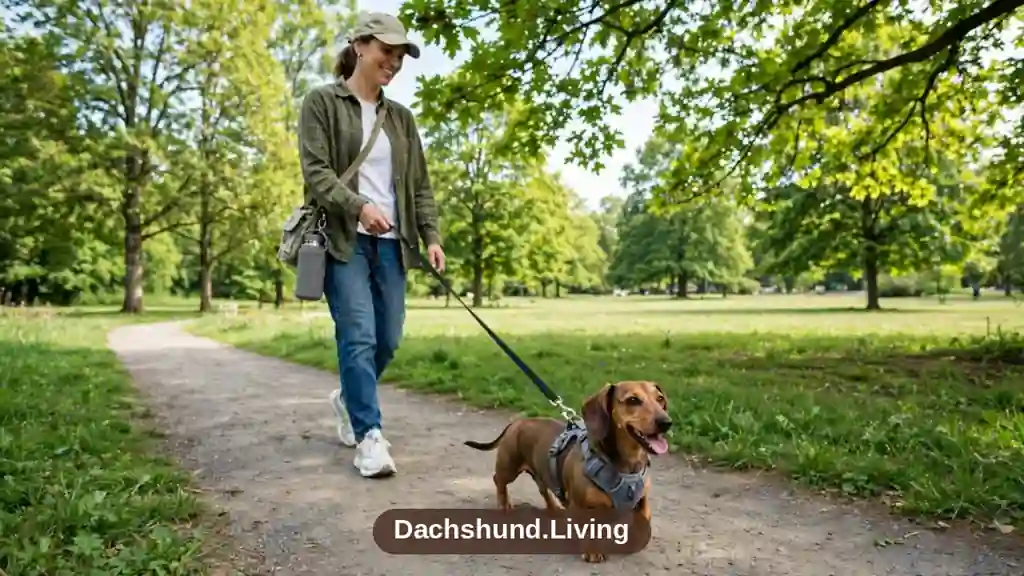

The harness decision stopped being about looks the day my dachshund lunged at a pigeon. He hit the end of a collar lead hard, coughed, and I heard the strain in his throat all the way home.
Nothing was seriously hurt, but I changed how we walk that same week. A dog built this long, with this much determination, needs the pulling force somewhere safer than his neck.
I am Umar, and I have fitted harnesses on miniatures and standards for years. This is what I look for now, how I measure, and the size table I start from before any harness goes near my dog.
Why a Harness, Not a Collar
A collar puts every pull on a small ring of neck. That means pressure on the windpipe and on the upper spine, exactly where a dachshund can least afford it.
A decent harness moves that force onto the chest and shoulders. The body is broader there, the load spreads out, and a sudden lunge becomes a tug you both feel rather than a jolt to the throat.
The VCA page on dachshunds sets out why this breed has to guard its back and neck so carefully. Our guide to dachshund IVDD and back problems covers the disc trouble that sits behind that advice.
He still wears a flat collar with his ID tags at home. The lead, though, clips to the harness on every walk, no exceptions for a quick trip to the gate.
What to Look For
A Y-Shaped Front
Look at the harness from the front before you buy it. The straps should form a Y, running around the neck and down between the front legs, leaving both shoulders free to move.
A straight strap across the chest looks tidy and walks badly. It can shorten his stride and rub the same spot on every outing, and dachshunds cover a lot of steps with those short legs.
Vest, step-in and Y-front: three different jobs
A vest harness spreads pressure across the chest and belly, which suits a relaxed walker and a dog who hates straps near his legs. A step-in harness does the same job with a different entry, since the feet go in first and nothing passes over the head. A Y-front harness keeps the straps clear of the shoulders, so it suits a dog who walks further or pulls in short bursts, and our guide to leash training to stop pulling pairs well with it.
Wide, Padded Straps
Thin straps dig in the moment a strong little dog pulls. Wide straps with soft padding spread the pressure across the chest and belly instead of cutting into one narrow line.
Run your fingers along the edges and seams, especially the parts that will sit behind his front legs. If it feels rough in your hand, it will feel worse on his skin after twenty minutes.
A Fit He Cannot Back Out Of
Dachshunds are escape artists with a reverse gear. Put a foot down, drop the head, walk backwards, and a loose harness comes off over the ears like a jumper.
The fix is a belly strap that sits well behind the ribcage, not bunched right behind the front legs. Plenty of adjustment points help too, because a deep chest and a slim waist rarely match a fixed shape.
Easy On and Off
Step-in styles suit dogs who hate anything passing over their heads, since the feet go in and the straps come up. Overhead styles with one buckle are faster once a dog accepts them, and mine did within a week.
Pick the style your dog tolerates calmly, not the one that looks clever in the shop. A harness that means a wrestling match at the front door will start getting left in the drawer.
Hardware That Holds
For a dog who lunges, metal D-rings outlast plastic clips by a long way. I check the stitching at every stress point as well, and I walk away from anything that looks decorative rather than sewn to work.
A ring on the back suits a relaxed walker and keeps the lead clear of his legs. A ring on the chest gives you steering when he pulls, turning him gently toward you instead of letting him lean in.
Walking harness or car harness
A walking harness is not a car restraint, even when it feels sturdy. A crash-tested car harness is built and tested to hold a dog in a sudden stop, and the Center for Pet Safety list the harnesses that passed their crash testing. Check the size and the fitting instructions for the exact model before you buy, since a car harness that fits loosely can still let a small dog slide forward.
Use the car harness only for travel and the walking harness only for walks. Swapping between them also keeps the walking harness dry and free of car smells, which matters to a dog who reads the world by scent.
How to Measure Your Dachshund
Guessing by weight alone has given me my worst fits. Two dachshunds can weigh the same and carry it in completely different chests, so the tape measure decides.
- Stand your dog on a flat floor, on all four feet, as square and relaxed as you can get him. A treat held at nose height helps.
- Find the widest part of his chest, just behind the front legs, where the ribs are at their fullest.
- Wrap a soft tape around that widest point, all the way round his body. Keep it level, snug against the coat, but not pulling tight.
- Read the measurement where the tape meets. You should still be able to slide two fingers under the tape.
- Measure the base of his neck too, low down where a collar would sit loosely, since some harness sizes ask for both numbers.
- Write both numbers down and measure again on another day if the first reading sits between two sizes.
Measure a long-haired dog down to the skin, not over the fluff. Coat adds centimetres on the tape that vanish the moment a strap settles in.
Size Guide by Chest
Brands size their harnesses differently, so treat this table as a starting map, not a promise. Your two measurements and the maker size chart for that harness always have the final say.
| Harness size | Chest girth | Usually fits |
|---|---|---|
| XS | 28 to 35 cm | Very small or young miniatures |
| S | 35 to 43 cm | Most adult miniatures |
| M | 43 to 52 cm | Large miniatures and small standards |
| L | 52 to 62 cm | Most adult standards |
If your dog lands right on a border, his build makes the call. Deep-chested dogs in my house have usually been happier in the larger size, adjusted in, than squeezed into the smaller one.
The fit test once it is on is simple. Two fingers should slide under every strap, the chest strap should not ride up into his throat, and the belly strap should clear his front legs when he walks.
I recheck the fit about once a month. Weight changes and coat changes both shift it, which is why our guide on how much a dachshund should weigh sits next to the harness hook in my notes.
Even a small weight change can shift the fit on a dog this small, so recheck the chest measurement whenever his weight changes, his coat thickens for winter, or a strap starts sitting in a new place. If the tape shows a different number from last month, trust the tape and adjust the straps before the next walk. Our overweight dachshund weight loss plan explains how to bring weight down slowly if the harness keeps getting tighter.
Styles and When to Use Them
Step-in vest harnesses are the easiest starting point for most dogs I know. They spread pressure over a wide area, go on without touching the head, and suit everyday walks well.
Y-front walking harnesses give the best shoulder freedom, so they are my pick for active dogs on longer routes. Our breakdown of dachshund exercise needs shows the sort of daily distance they end up covering.
Front-clip harnesses earn their place with a determined puller. The lead attaches at the chest, so pulling turns the dog back toward you, and most dogs work out within a few walks that leaning in gets them nowhere.
The PetMD breed guide for dachshunds notes the strength packed into this small frame, and that strength is why the harness has to match the dog, not the trend in the park. A strong puller needs a front clip and wide straps, while a calm walker is fine with a back clip and a lighter build. The AKC guide to putting on a dog harness shows the fitting steps that catch a twisted strap or a clip sitting over a joint before you leave the house.
For an older dog, I look for a harness with a handle on top and soft padding throughout. The handle lets me steady him on curbs, and the routines in our senior dachshund care guide explain why that small help matters.
The First Time He Wears It
Rushing this part taught me a lesson with my first dog, who hid under the table at the sight of new gear for a month. Now the harness gets introduced like a game, in stages, with food doing the talking.
He sniffs it on the floor and gets a treat. It rests on his back for a few seconds, another treat, and then it comes off before he has time to worry.
Next session it clips on loosely indoors while we play, and only after that do we walk to the gate and back. Most dogs accept the whole thing within a few short sessions when nobody forces the pace.
Mistakes I See Often
The most common one is buying for the dog he might become. A puppy harness bought with growing room is a loose harness today, and loose is exactly how a young dog learns he can wriggle free at a busy corner.
The second is tightening everything to solve a shape problem. If straps need to be hauled in to their last hole to stop slipping, the shape is wrong for his chest, and a different style will serve you better than more force.
The third is forgetting the coat. A harness fitted over a clipped summer coat can vanish into a full winter coat, so owners with long-haired dogs should run the two finger test again whenever the coat changes.
Puppies need that recheck far more often, sometimes every two to three weeks while they are growing fast. I keep the tape in the same drawer as the harness so the check takes a minute, not a project.
Checks and Care
Before each walk I give the straps and buckles a quick once over. Stitching frays, clips crack, and a dog who chews can weaken a strap in one quiet afternoon.
Rubbing: the warning signs to check for
Check behind the front legs and under the chest strap after every walk for the first month with a new harness. Red skin, a bald patch, flaking, or a dog who flinches when you touch the area all mean the fit or the style is wrong, even if the harness looked fine in the shop. Stop using it and ask your vet if the skin is broken or sore, and read our guide to dachshund IVDD and back problems if he also seems stiff, reluctant to move, or yelps when lifted.
The harness comes off indoors in my house. Skin breathes, coats do not mat under straps, and a rub I might have missed on the walk shows up while I can still fix the fit.
Wash it when it gets gritty, following the maker instructions, and let it dry fully before the next outing. Grit and dried sweat under a strap are a fast route to sore skin.
Two safety rules never bend here. He is never tied out on a harness unsupervised, and the harness never pairs with a retractable lead near traffic, where a sudden run out can build real speed before the brake bites.
For daily walks I use a plain lead of 4 to 6 feet. It gives him room to sniff, keeps him out of the road, and leaves me enough control when a scent takes over.
Frequently Asked Questions
Harness or collar for a dachshund?
A harness for walks, so pulling pressure lands on the chest instead of the neck and throat. Keep a flat collar with ID tags for identification, and clip the lead to the harness.
How do I stop him backing out of it?
Choose a harness with a belly strap sitting well behind the ribcage and several adjustment points. Fit it with the two finger rule, and avoid designs where every strap bunches behind the front legs.
Can he wear a harness all day?
Better not. All day wear can rub the skin, mat the coat and hide a fit problem until it is sore, so put it on for walks and outings and take it off at home.
Front clip or back clip?
Back clip suits calm walkers and keeps the lead out from under his feet. Front clip gives you more control with a puller, and many harnesses offer both rings so you can switch as training improves.
How tight should a harness be?
Snug enough that two fingers slide under each strap and no more. Looser than that invites an escape, tighter restricts breathing and rubs, so check it again after the first few minutes of a walk.
Measure first, buy second. Every harness regret in my house came from guessing a size or skipping the slow introduction. Ten minutes with a tape measure and a few treats will save you both a lot of tugging later.
A quick note to close. I am an owner sharing what has worked with my own dogs, not a vet or a trainer, and this article is not professional advice. If your dog has back trouble, breathing issues or sore skin under a harness, check with your own vet before the next walk.





[…] is tiring in the best way. Use a harness rather than a collar to protect the neck and spine. Our harness guide for Dachshunds covers fit and […]
[…] you do not want it. A well-fitted harness spreads force across the chest instead. Our guide to the best harnesses for dachshunds covers what to look for in fit and […]
[…] you choose, a snug fit matters, and my guide to choosing the right harness for a dachshund covers what to look for if you use one for lifting and […]
[…] roundup of the best harnesses for dachshunds covers the shapes that suit a deep chest and short legs, including front clip styles that gently […]
[…] short outdoor steps too. It gives you a steady hold without pulling on the neck, and our picks for the best harnesses for dachshunds explain what to look for in a good […]
[…] rule, since a poor chest fit bunches fabric and leaves the back exposed. My tested picks in the best harnesses for dachshunds guide all start from a proper chest […]
[…] windpipe weakens and flattens, and VCA Hospitals lists a honking cough as the classic sign. Use a harness, never a collar that pulls on the throat, and raise a honking cough with your vet early, because it […]
[…] chest without pressing on the throat, and the dog should still sit up and lie down. My guide to the best harnesses for dachshunds covers measuring that long chest at […]